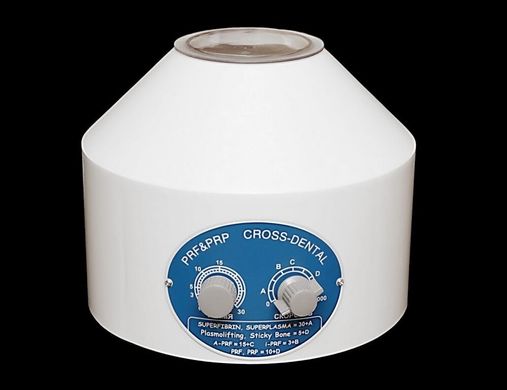
The upgraded centrifuge offers several advantages over comparable models:
- 4-fold reduction in vibration levels;
- precise RPM calibration;
- gradual thermostatic temperature control function;
- convenient selection of centrifugation programs.
VIDEOS:
No. 1 https://www.facebook.com/CrossDentalShop/videos/1691533520925864/
No. 2 https://www.facebook.com/CrossDentalShop/videos/719493675061773/
This is a new 2018 model centrifuge! It makes selecting the appropriate centrifugation mode for different applications quick, easy, and convenient: PRF, A-PRF, i-PRF, Superfibrin, Superplasma, plasma lifting, and PRP. The centrifuge comes with a Russian-language instruction manual containing recommendations for achieving successful results, as well as a table showing centrifugation times and speeds for different applications.
Would you like to purchase a centrifuge for preparing PRF and PRP clots and for plasma lifting? Place your order now!
Centrifuge features: stepwise RPM adjustment (500 RPM increments), maximum speed of 4,000 RPM, and a timer of up to 30 minutes.
The overall impression is very positive. It operates fairly quietly and does not shake. The rubber feet are a particularly good feature, as they adhere firmly to the table. The speed is adjustable in increments of 500 RPM, from 500 to 4,000 RPM. The timer can be set from zero to 30 minutes. There are six tube holders, each measuring 20 mm in diameter and 100 mm in length. Standard 5, 9 and 10 mL vacuum blood collection tubes can be used.
This centrifuge is ideally suited for preparing PRF (i-PRF, A-PRF), PRP, and for plasma lifting procedures.
Warranty: 12 months.
Our store also offers a centrifuge with continuously variable speed control and a timer of up to 60 minutes.
We also recommend purchasing a PRF Box for preparing membranes of the desired thickness.
Indications for PRF
- Sinus lift procedures
- Soft-tissue augmentation
- Bone augmentation
- Filling periodontal defects
- Filling post-extraction sockets
- Wound healing
---
Why Dr. Choukroun’s A-PRF?
Many recent studies have demonstrated the potential of leukocytes, during the early stages of the inflammatory cascade, to stimulate progenitor cells to differentiate into bone tissue (Omar Omar and Peter Thomsen, Biomaterials, 2012; Kawazoe T. et al., Cell Transplantation, 2012).
Therefore, it would be logical to attempt to capture all monocytes within the PRF clot so that it could stimulate bone grafts more actively and promote the faster transformation of monocytes into macrophages, thereby enhancing bone stimulation.
This result can be achieved using A-PRF (Advanced PRF).
The entire protocol has changed!
The tubes, centrifuge speed, and centrifugation time.
The initial results of our research, conducted at the Clarion Research Group laboratories at the University of Pennsylvania (USA) and at Repair-Lab, Institute of Pathology, Johannes Gutenberg University Mainz (Germany), demonstrated the release of BMP-2 (bone morphogenetic protein) and BMP-7. These studies also showed increased VEGF (vascular endothelial growth factor) release. Apparently, these factors are released by monocytes.
It can now be stated with confidence that the presence of sufficient quantities of BMP in A-PRF makes it a highly potent material for bone tissue reconstruction in clinical practice.
What is PRF?
Platelet-Rich Fibrin (PRF): Dr. Choukroun’s centrifugation systems.
Platelet-Rich Fibrin (PRF) is an autologous matrix obtained from the patient's own blood. Its simplified preparation procedure, performed directly in the dental office, allows a fibrin membrane to be produced quickly without losing its potential to stimulate bone and soft-tissue growth. This material is rich in leukocytes and vascular endothelial growth factors (VEGF).
PRF also enables the sustained release of platelet-derived growth factors (PDGF), proteins that play an important role in angiogenesis; transforming growth factor beta (TGF-beta), proteins that stimulate tissue growth; and thrombospondin-1, a viscous glycoprotein involved in intercellular interactions and angiogenesis.
The presence of these proteins in the material promotes rapid healing, which is particularly important during the first and most critical days.
The main property of this autologous biomaterial (PRF) is the slow release of growth factors over a period exceeding 7 days. Such sustained release is possible when using a PRF membrane, but not when using PRP (platelet-rich plasma) or PRGF (plasma rich in growth factors).
The PRF Box is a special tray used to prepare membranes of uniform thickness and size. The PRF exudate obtained using the box contains large amounts of proteins that promote increased cell attachment to biomaterials and titanium.
Clinically, the membrane is easy to handle. It is elastic, strong, and flexible, making it easy to manipulate, cut, and suture. PRF is also highly stable at room temperature, providing sufficient working time.
These membranes are easy to prepare using a PRF Box, and their structure closely resembles the natural postoperative fibrin network. The biological and biomimetic properties of this membrane not only stimulate cell migration and proliferation but also eliminate the need for biochemical additives or anticoagulants.
The membrane can be prepared easily in the dental office. Essentially, the procedure involves centrifuging a specified quantity of the patient's blood according to the protocol, removing the resulting clot, trimming it, and placing it in the box to obtain a membrane of the required thickness.
Indications
- Sinus lift procedures
- Soft-tissue grafting
- Bone grafting
- Periodontal defects
- Post-extraction sockets
- Wound healing
The membranes are prepared from the patient's own blood.
Advantages of PRF membranes
- Fibrin-enriched
- Support angiogenesis and stimulate tissue growth
- Promote rapid healing, particularly during the first 7 days
- Can be prepared directly in the dental office
- Contain factors absent from PRGF and PRP
- Excellent handling properties: easy to manipulate, cut, and suture
- Provide an extended working time
- Feature a fibrin network closely resembling the natural structure
Clinical results of PRF application
Clinical results from the use of PRF indicate faster tissue healing.
Factors contributing to accelerated tissue healing:
- Effective neovascularization
- Faster wound closure
- Rapid remodeling of scar tissue
- Virtually no risk of infection